Study in Canada university campus

Canada Flag Study in Canada

Discover top universities, visa process, work opportunities, PR chances, and everything you need to study in Canada.

Explore Now
👇 Scroll to Bottom

S t u d y   i n   C a n a d a  🎓📺

Historic building of The University of British Columbia (UBC) in Burnaby, British Columbia, Canada – a top-ranked institution to Study in Canada for international students.
Building of The University of British Columbia (UBC), Burnaby, British Columbia, Canada – one of the best universities to Study in Canada, known for its world-class education and stunning architecture.

🎓✨ Top Universities to Study in Canada 🇨🇦

If you plan to Study in Canada, choosing the right university is essential for shaping your academic and professional future. Below is a list of the most prestigious and globally recognized universities where you can Study in Canada with world-class education and global exposure. 🌍

  • 🎓 University of Toronto – One of the most renowned institutions to Study in Canada, known for outstanding research programs and diverse faculties. 📚
  • 🏫 University of British Columbia (UBC) – A top choice to Study in Canada for students who value beautiful campuses and academic excellence. 🌲
  • 🎓 McGill University – Located in Montreal, this university is highly regarded for medical and law faculties, making it a popular option to Study in Canada. ⚖️
  • ⚙️ University of Alberta – Offers excellent opportunities in engineering, business, and environmental sciences for those who wish to Study in Canada. 🌿
  • 💉 McMaster University – Known for its health sciences and innovative teaching methods, ideal for students aiming to Study in Canada. 🧬
  • 💻 University of Waterloo – A leading institution in technology and research, perfect for students who want to Study in Canada in STEM fields. 🚀
  • 💼 Western University – Provides high-quality education in business, law, and management, a valuable choice to Study in Canada. 📈
  • 👥 Queen’s University – Famous for its strong community culture and global connections, ideal for international students who want to Study in Canada. 🌐
  • 🔬 University of Calgary – Known for research and innovation, it offers a dynamic academic environment to Study in Canada. 💡
  • 🌊 Dalhousie University – Among the best universities to Study in Canada for students interested in marine research and engineering. 🧭
  • 🗣️ University of Ottawa – A bilingual institution (English & French), popular among international students who choose to Study in Canada. 🇨🇦
  • 🎭 York University – A balanced choice to Study in Canada with strong programs in business, arts, and social sciences. 🖼️
  • 🌾 University of Saskatchewan – A top destination to Study in Canada for agriculture, veterinary, and research fields. 🧪
  • 🏙️ Simon Fraser University – Located in Vancouver, ideal for students looking to Study in Canada with modern curriculum and global exposure. 🌏
  • 💰 Concordia University – Offers affordable yet quality education for students planning to Study in Canada in Montreal. 💡
  • 📰 Carleton University – Provides excellent opportunities to Study in Canada in media, public policy, and international relations. 🧭

✈️ Why Choose to Study in Canada? 💡

There are countless benefits when you decide to Study in Canada — from world-class education 🎓 and a safe environment 🛡️ to a multicultural society 🌍 and global career opportunities 💼. Every year, thousands of students turn their dream to Study in Canada into reality, gaining internationally respected degrees and lifelong experiences. 🌟

🇨🇦 Start your journey today and Study in Canada for a brighter future! ✨

Street view of Montreal, Canada, showing diverse people and workplaces — representing international students’ lifestyle and work rights while studying in Canada.
A vibrant street view of Montreal, Canada – symbolizing the multicultural environment and work opportunities available for international students studying in Canada.

💼🇨🇦 Work Rights for International Students in Canada

  • 🎓 On-Campus Jobs: Students can work on campus without a work permit, gaining valuable academic experience while they study in Canada.
  • 🏫 Off-Campus Work: International students can work up to 20 hours per week during semesters and full-time during breaks. This helps them manage expenses while they study in Canada.
  • 🔧 Co-op & Internship Programs: Some programs include mandatory work placements, providing real-world training. A separate Co-op Work Permit is required. ⚙️
  • 🎓 Post-Graduation Work Permit (PGWP): After completing their studies, students can work in Canada for up to 3 years — an incredible opportunity to gain global experience. 🌍
  • 💑 Spouse Work Permit: Spouses or common-law partners of full-time students may qualify for an open work permit in Canada. ❤️
  • 💰 Part-Time Jobs: Students can take up flexible part-time jobs such as barista, tutor, or research assistant to earn extra income while they study in Canada. ☕
  • 💻 Remote & Online Work: Students with digital skills can work remotely for international companies while staying in Canada. 💼
  • 🏢 Career Development Programs: Many Canadian universities offer job fairs, mentorships, and networking events to help students transition to the professional world. 🤝
  • 🚀 Permanent Residency Pathways: After working under PGWP, international graduates may qualify for Canadian Permanent Residency under Express Entry or PNP programs. 🇨🇦
  • 🌟 Work-Life Balance: Canada promotes flexible working hours and safe job conditions for students, ensuring they can balance education and employment effectively. 🌈

💼✨ International students who study in Canada can work part-time during semesters, full-time during vacations, and gain hands-on experience to build a successful career in Canada. 🇨🇦

Two international students walking on a university campus in Canada, holding books and papers, symbolizing PR pathways after study in Canada.
International students walking on a Canadian university campus – representing opportunities for PR pathways after completing their studies in Canada.

🧾🇨🇦 PR Pathway After Study in Canada

  • 🎓 Post-Graduation Work Permit (PGWP): Gain Canadian work experience for up to 3 years after graduation and improve your eligibility for PR in Canada.
  • 💼 Canadian Experience Class (CEC): Apply for Permanent Residency through Express Entry after one year of skilled Canadian work experience.
  • 🏙️ Provincial Nominee Program (PNP): Each province offers PR pathways for international graduates with job offers and local experience.
  • 🗣️ Quebec Experience Program (PEQ): For students who study and live in Quebec, having French language proficiency can lead to PR faster.
  • 🌊 Atlantic Immigration Program (AIP): Designed for graduates from Atlantic provinces such as Nova Scotia, New Brunswick, Newfoundland, and PEI with valid job offers.
  • 🧑‍💼 Rural & Northern Immigration Pilot (RNIP): Provides PR opportunities for students who choose to live and work in smaller Canadian communities. 🌾
  • 🚀 Agri-Food Immigration Pilot: For graduates working in the agriculture and food-processing sectors, offering direct PR eligibility. 🍁
  • 🏫 Educational Credential Advantage: Canadian study credentials boost your CRS score for PR under Express Entry. 🎓
  • 📈 Work Experience in Canada: The more skilled Canadian work experience you have, the stronger your PR profile becomes. 💪
  • 🌟 Path to Permanent Residency: Combining Canadian education, work experience, and language proficiency creates the best pathway to Study in Canada and settle permanently. 🇨🇦

🧾 Students who Study in Canada can apply for PR through PGWP, CEC, PNP, PEQ, AIP, or RNIP programs after completing their education. 🌍

A woman enjoying Canadian food decorated with the national flag during a student gathering, representing cost of living and daily lifestyle in Canada.
Canadian student enjoying local food and desserts – symbolizing the average cost of living in Canada for international students.

💰🇨🇦 Cost of Living in Canada for International Students

  • 🏠 Accommodation: $600–$1,200 per month depending on location and housing type (shared, private, or apartment).
  • 🍎 Food & Groceries: Around $250–$400 per month on average, based on personal preferences and city.
  • 🚌 Transportation: Public transport pass costs about $80–$120 per month. Some universities offer student discounts. 🚉
  • 💊 Health Insurance: Approximately $600–$900 per year depending on the province or coverage plan.
  • 📶 Internet & Phone: $50–$100 per month combined for mobile and Wi-Fi services. 📱
  • 🎬 Entertainment & Leisure: $100–$200 per month for movies, dining out, and social activities. 🎭
  • 📚 Books & Study Materials: $300–$800 per academic year, depending on the program of study. 📖
  • 👕 Clothing & Essentials: $50–$150 per month, especially higher during winter season for jackets and boots. 🧥
  • Personal Expenses: $100–$200 per month for toiletries, coffee, and day-to-day needs. 🛍️
  • 🏦 Total Monthly Budget: On average, international students who study in Canada spend between $800–$1,500 per month depending on city and lifestyle. 💼

💡 The cost of living in Canada varies by city — Toronto and Vancouver are more expensive, while smaller cities offer affordable living for international students. 🇨🇦

Group of international students working together on laptops during a project, representing career opportunities and post-study employment in Canada.
International students collaborating on a project in Canada – symbolizing teamwork, innovation, and post-study career opportunities for graduates.

🎓📊 Career Data & Post-Study Statistics in Canada

  • 🇨🇦 Over 800,000+ international students are currently studying in Canada (as of 2024), making it one of the top global education destinations.
  • 🌏 About 40% of these students are from India, followed by students from China, the Philippines, Nigeria, and South Korea.
  • 💼 Post-Graduation Work Permit (PGWP): Allows graduates to work in Canada for up to 3 years after completing their studies.
  • 💻 Top Hiring Sectors: IT, Healthcare, Business, Engineering, Education, and Finance remain the most in-demand industries. 📈
  • 🧑‍💼 Average Starting Salary: International graduates earn between CAD $45,000 – $65,000 annually depending on the field. 💰
  • 🎯 Express Entry PR Route: Skilled graduates can apply for permanent residency through Express Entry and Provincial Nominee Programs (PNP).
  • 🏫 University Support: Many Canadian universities offer career fairs, internships, and co-op placements that help students gain work experience. 🤝
  • 📊 Employment Rate: Nearly 90% of international students find a job within 6 months after completing their studies in Canada. 🎓
  • 🌍 Work-Life Balance: Canada’s professional environment promotes flexible work hours and inclusive workplace culture. ⚖️
  • 🚀 Career Growth: Graduates who study in Canada benefit from one of the world’s most stable economies and high demand for skilled workers. 🌟

📘 After you study in Canada, a world of career opportunities awaits — from top global companies to thriving startups, Canada provides a platform for international success. 🇨🇦

A skilled trade worker using tools in a workshop, representing construction and technical job sectors in Canada for international students.
A skilled professional working in a Canadian workshop – symbolizing construction, engineering, and technical job opportunities for international students.

🎯 Popular Job Sectors for International Students in Canada

  • 💻 Information Technology (IT): High demand for software developers, cybersecurity experts, data analysts, and cloud engineers across Canada.
  • 🏥 Healthcare: Nursing, medical lab assistance, caregiving, and health administration roles are always in demand. 👩‍⚕️
  • 🛠️ Engineering: Civil, Mechanical, Electrical, and Software Engineers are frequently hired for Canada’s growing infrastructure projects. 🏗️
  • 💼 Business & Finance: Banking, auditing, consulting, and fintech jobs are popular among international graduates. 💰
  • 📊 Data Science & AI: Machine Learning, Artificial Intelligence, and Big Data jobs are rising rapidly across major cities like Toronto and Vancouver. 🤖
  • 🛎️ Hospitality & Tourism: Opportunities in hotels, restaurants, and travel industries — great for part-time student work. ✈️
  • 🛍️ Retail & Customer Service: Flexible part-time roles for students with strong interpersonal and sales skills. 🛒
  • 🎓 Education & Research: Positions like teaching assistant, academic researcher, and fellowship coordinator are open to graduates. 📚
  • ⚙️ Construction & Skilled Trades: Technicians, electricians, and supervisors remain vital to Canada’s workforce. 🧰
  • 🌿 Green Energy & Environment: Sustainability, renewable energy, and environmental safety careers are expanding fast. 🌎

💡 Tip: Gain Canadian work experience through internships, co-op programs, and PGWP to enter these top job sectors successfully. 🇨🇦

A happy student holding money while sitting near a laptop, representing scholarships and financial aid available for international students studying in Canada.
An international student receiving scholarship funds – symbolizing financial aid and study opportunities in Canada.

🎓 Scholarships & Financial Aid in Canada

  • 🏅 Merit-Based Scholarships: Awarded to students with excellent academic performance and leadership qualities.
  • 💰 Need-Based Aid: Provided to students from financially weaker backgrounds to support their study expenses.
  • 🎯 Government Scholarships: Offered by the Canadian government (e.g., Vanier Canada Graduate Scholarship, Canada-ASEAN Scholarships).
  • 🏫 University-Specific Awards: Many universities in Canada offer entrance, in-course, and departmental scholarships for international students.
  • 🤝 Private Scholarships: Provided by NGOs, private foundations, and alumni associations to encourage global education.
  • 🔬 Research Assistantships: Offered to graduate and postgraduate students engaged in research, lab work, or faculty-led projects.
  • 📚 Teaching Assistantships: Opportunities for graduate students to assist professors while earning stipends and tuition fee reductions.
  • 🌍 International Collaboration Grants: Scholarships that promote global student exchange and cross-border education initiatives.
  • 🎓 Postgraduate Fellowships: For PhD and master’s students conducting innovative research in Canadian universities.
  • 💡 Entrance Scholarships: Automatically awarded to top international applicants at the time of admission.

💡 If you plan to Study in Canada without financial stress, explore multiple scholarship options offered by both the government and universities. Applying early increases your chances of receiving financial aid. 🇨🇦

International students engaged in practical learning with a human anatomy model, representing the high-quality and hands-on education system in Canada.
International students exploring science through practical learning in Canada.

✅ Pros & ❌ Cons of Studying in Canada

✅ Pros

  • 🎓 World-Class Education: Top-ranked universities with globally recognized degrees.
  • 💼 Work Opportunities: Students can work part-time and gain valuable experience.
  • 🌍 Diverse Culture: Welcoming multicultural environment with global exposure.
  • 🇨🇦 Pathway to PR: Opportunities to apply for permanent residency after graduation.
  • 🩺 Excellent Healthcare: Access to high-quality, affordable medical care.
  • 🕊️ Safe Country: Ranked among the safest nations in the world for students.
  • 🔬 Research Opportunities: Leading hub for innovation and academic research.
  • 💰 Scholarship Options: Availability of merit-based and government scholarships.
  • 🏫 Supportive Universities: Career counseling and co-op work programs offered.
  • 🌆 Quality of Life: Clean cities, friendly people, and high living standards.

❌ Cons

  • 💸 High Living Costs: Expensive housing and lifestyle in major cities.
  • 🥶 Cold Weather: Harsh winters, especially in northern provinces.
  • Visa Delays: Study permit processing can sometimes be slow.
  • 🏘️ Limited Housing: Affordable student accommodation is hard to find.
  • 💰 Expensive Tuition: Some specialized courses are costlier than others.
  • 🎯 Competitive Admissions: Top universities have strict eligibility criteria.
  • 📄 Documentation Load: Complex application and paperwork process.
  • 🕒 Work Balance: Managing part-time jobs with study can be stressful.
  • 🌐 Cultural Adjustment: Takes time to adapt to a new country and climate.
  • 📉 Rural Limitations: Fewer jobs and opportunities outside large cities.

💡 Before you Study in Canada, compare both the benefits and challenges to make an informed, confident decision. 🇨🇦

A female international student participating in an outdoor fitness training session, representing active student life and extracurricular activities in Canada.
International student enjoying outdoor sports activity in Canada — showcasing an active and balanced student life.

🎭 Extracurricular Activities for International Students in Canada

  • 🎓 Join Student Clubs & Societies: Get involved in academic, cultural, or hobby-based organizations to expand your network.
  • Sports & Recreation: Participate in university sports teams, fitness centers, and recreational clubs to stay active and healthy.
  • 🤝 Volunteer Opportunities: Contribute to community service projects and nonprofit organizations while building social connections.
  • 🎤 Workshops & Networking: Attend campus workshops, seminars, and professional meetups to enhance career skills.
  • 🧭 Leadership Roles: Become a student ambassador, club leader, or council representative to develop leadership experience.
  • 🎨 Creative Arts & Culture: Join theater, music, dance, or photography clubs to explore creativity and expression.
  • 💬 Public Speaking & Debates: Participate in debate societies and speech contests to improve communication confidence.
  • 🌍 International Events: Engage in multicultural festivals and student exchange programs to celebrate diversity.
  • 📚 Academic Competitions: Take part in hackathons, science fairs, or business case challenges organized by universities.
  • 🚀 Skill-Building Programs: Learn teamwork, time management, and adaptability through extracurricular projects.

🌟 While you study in Canada, boost your profile by engaging in vibrant extracurricular activities that nurture leadership, creativity, and confidence. 🇨🇦

Two international students studying and relaxing in a cozy apartment, representing the comfortable and multicultural student life in Canada.
International students enjoying relaxed campus life in Canada — blending learning and friendship.

🎓 Student Life in Canada

  • 🏫 Modern Campuses: Canadian universities feature advanced classrooms, labs, and technology-equipped facilities.
  • 🌍 Multicultural Environment: Students from over 150 countries bring diverse perspectives and global connections.
  • 🎯 Clubs & Societies: Join academic, cultural, and sports clubs to build friendships and leadership skills.
  • 🏃‍♀️ Active Lifestyle: Participate in campus recreation, gym facilities, and sports tournaments year-round.
  • 🤝 Community Engagement: Volunteer in student initiatives and local charities to make a positive impact.
  • 🎉 Events & Festivals: Enjoy multicultural events, concerts, and celebrations on and off campus.
  • 🚍 Affordable Transport: Access student discounts on buses, metros, and intercity travel passes.
  • 🛏️ Comfortable Accommodation: Choose from on-campus dorms, shared apartments, or homestays.
  • 🍽️ Diverse Food Options: Experience global cuisines in cafeterias and local restaurants near campus.
  • 🧘‍♀️ Student Wellbeing: Universities offer free counselling, health insurance, and support services for all students.

✨ Experience vibrant student life in Canada filled with learning, fun, and friendships — a perfect balance between academics and lifestyle. 🇨🇦

Smiling student holding a passport and travel documents, showing excitement after getting her Canada study visa approved.
Excited student celebrating her Canada study visa approval — ready to begin her study journey abroad.

🛂 Visa Requirements for Studying in Canada

  • 📘 Valid Passport: Must have at least 6 months validity beyond your intended study period.
  • 🏫 Letter of Acceptance (LOA): From a Designated Learning Institution (DLI) in Canada.
  • 💰 Proof of Funds: Show sufficient financial resources for tuition, living expenses, and return travel.
  • 👮 Police Clearance Certificate: Required for certain applicants to ensure good conduct.
  • ⚕️ Medical Examination: Conducted by an authorized physician if applicable.
  • 📝 Statement of Purpose (SOP): Explains your academic goals and why you wish to study in Canada.
  • 📄 Visa Application Process: Apply through SDS (Student Direct Stream) or Non-SDS stream depending on eligibility.
  • 📧 Biometrics & Documentation: Submit fingerprints, photo, and supporting documents as per IRCC guidelines.
  • ⏱️ Processing Time: Usually 3–8 weeks, depending on your country of residence.
  • 🌐 Apply Online: Visit the official Canada Immigration Website to begin your visa process.

✨ Learn all the visa requirements for studying in Canada — from passport to SOP and SDS process — to make your study abroad journey smooth and successful. 🇨🇦

Toronto skyline view at dusk featuring the CN Tower — representing Canada’s top study destinations and university application intakes.
Toronto skyline featuring the CN Tower — symbolizing new beginnings for international students planning their study in Canada journey.

🗓️ Intakes & Deadlines in Canada

  • 🍁 Fall Intake (September): Most popular intake with the widest range of programs. Applications usually open from December to March.
  • ❄️ Winter Intake (January): Offers limited programs; ideal for those who missed fall intake. Apply between July and September.
  • 🌼 Summer Intake (May): Few colleges and programs available; best for short-term or diploma courses. Apply by October to February.
  • 📅 Deadlines Vary: Each university has its own admission timeline — always check the official university website.
  • Apply Early: Submitting applications early increases your chances for admission and timely visa processing.
  • 🎓 Popular Programs: Engineering, Business, Computer Science, and Health Sciences see the highest intake during Fall.
  • 📈 Admission Tips: Prepare SOPs, recommendation letters, and English test scores before deadlines.
  • 🌐 International Students: Early application helps secure preferred universities and scholarship options.
  • 📆 Application Window: Many institutions open applications almost 8–10 months before the session start.
  • 🧭 Next Step: Once accepted, proceed with your study permit and accommodation planning. 🇨🇦

📚 Plan your study in Canada journey smartly by tracking intake schedules and application deadlines. Applying early ensures a smoother admission and visa experience.

A "Now Hiring" signboard in Canada showing full-time and day staff wages — representing post-study job opportunities and work options for international graduates.
Now Hiring” sign in Canada — showcasing employment opportunities for international graduates after completing their studies.

💼 Post-Study Career Opportunities in Canada

  • 🎓 Post-Graduation Work Permit (PGWP): Allows graduates to work in Canada for up to 3 years after completing their studies, gaining valuable international experience.
  • 💻 Skilled Job Market: Growing demand in sectors like IT, Healthcare, Business, Engineering, and Skilled Trades across major Canadian cities.
  • 🏠 Permanent Residency (PR) Options: Eligible graduates can apply through Express Entry, PNP, or CEC programs for long-term settlement in Canada.
  • 🤝 Career Services: Universities offer career counseling, workshops, co-op placements, and job search guidance to help students transition into the workforce.
  • 🌐 Networking Events: Frequent job fairs, alumni meetups, and industry events help international students connect with Canadian employers.
  • 📈 High Employment Rate: Over 90% of international graduates find employment within six months of graduation in relevant fields.
  • 🧾 Co-op & Internship Programs: Many degree programs include paid internships that enhance practical experience before graduation.
  • 💬 Employer Support: Canadian employers actively hire skilled graduates through work permit pathways.
  • 🎯 Work-Life Balance: Canada’s flexible job environment encourages healthy professional and personal growth.
  • 🚀 Long-Term Growth: After gaining experience, graduates can move into managerial or professional roles with attractive pay scales.

🌟 Explore exciting post-study career opportunities in Canada and build a rewarding professional journey after your graduation. Canada offers a pathway from education to employment — and beyond! 🇨🇦

A student raising hand to ask a question in class, representing curiosity and learning — ideal for Frequently Asked Questions (FAQs) section.

Frequently Asked Questions (FAQs)

Q1. What is the minimum IELTS score required for studying in Canada?

Most Canadian universities require an IELTS score of 6.0–6.5 overall, with no band less than 6.0.

Q2. Can international students work part-time while studying in Canada?

Yes, international students can work up to 20 hours per week during semesters and full-time during breaks.

Q3. How long does it take to get a Canada student visa?

It usually takes 4–8 weeks depending on the application time and country of origin.

Q4. Is health insurance mandatory for international students in Canada?

Yes, all international students are required to have valid health insurance during their stay in Canada.

Q5. What are the best cities in Canada for international students?

Toronto, Vancouver, Montreal, and Ottawa are among the top cities offering excellent education and multicultural life.

Q6. What is the average cost of living for students in Canada?

It ranges from CAD 800 to CAD 1,500 per month depending on city, accommodation, and lifestyle.

Q7. Can I stay in Canada after completing my studies?

Yes, graduates can apply for a Post-Graduation Work Permit (PGWP) and later for permanent residency.

Q8. When should I apply for Canadian university intakes?

Apply 6–9 months before your desired intake — Fall (September), Winter (January), or Summer (May).

Q9. Are scholarships available for international students in Canada?

Yes, many universities and government programs offer scholarships to international students based on merit and need.

Q10. Can I bring my family while studying in Canada?

Yes, international students can bring their spouse and children on dependent visas; spouses may get open work permits.

💡 Find detailed answers to all your questions about studying in Canada — covering IELTS, visa, scholarships, jobs, and student life.

Two smiling graduates in black caps and gowns holding “It’s Graduation!” and “Finally!” signs while posing in front of tall columns.
Graduates celebrating with signs that say “It’s Graduation!” and “Finally!” in front of large campus columns.
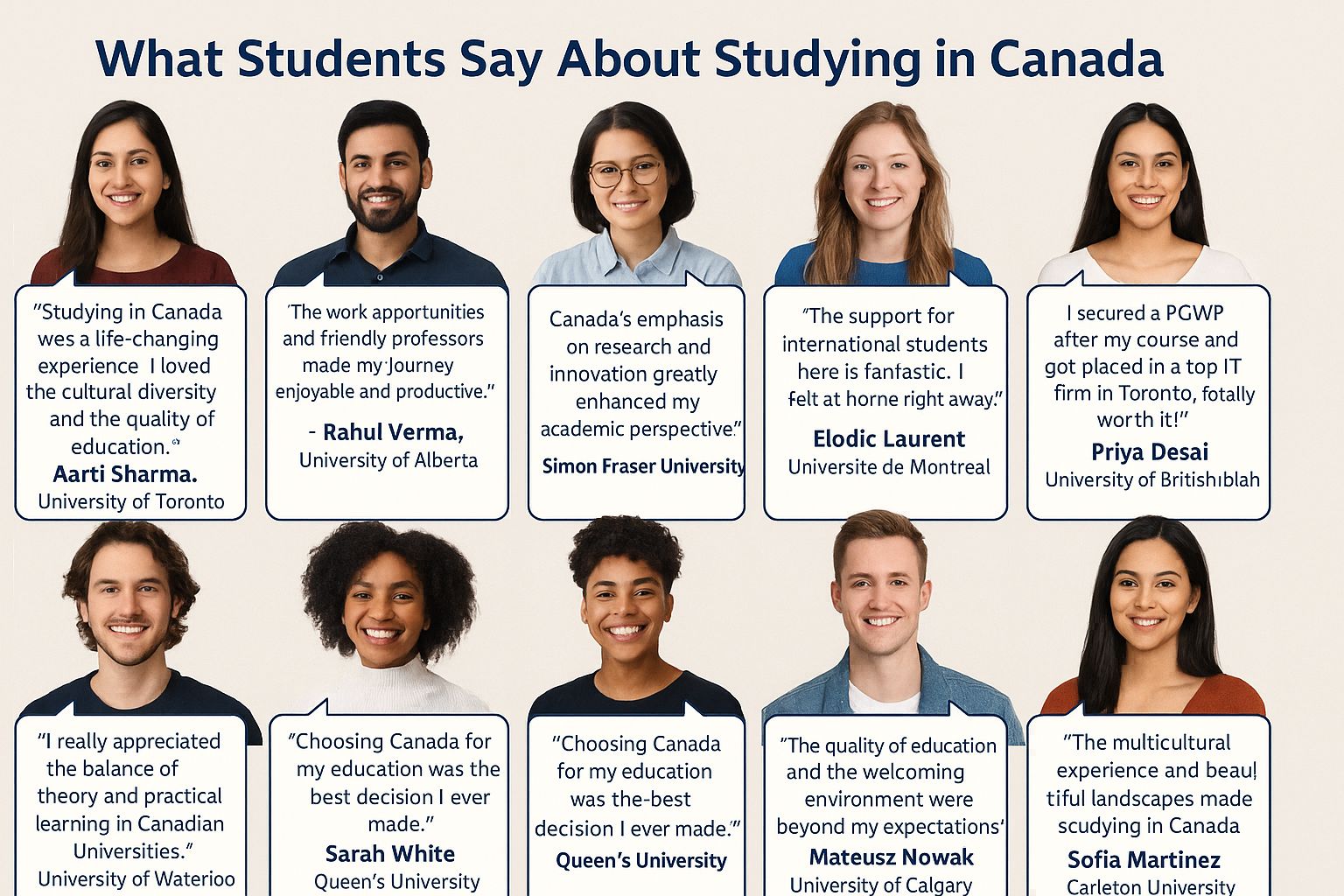
What Students Say About Studying in Canada – collage of ten international students with quotes
What Students Say About Studying in Canada – Student Testimonials

What Students Say About Studying in Canada

“Studying in Canada was a life-changing experience. I loved the cultural diversity and the quality of education.”

Aarti Sharma

University of Toronto

“The work opportunities and friendly professors made my journey enjoyable and productive.”

Rahul Verma

University of Alberta

“Canada’s emphasis on research and innovation greatly enhanced my academic perspective.”

Simon Fraser University

“The support for international students here is fantastic. I felt at home right away.”

Elodie Laurent

Université de Montréal

“I secured a PGWP after my course and got placed in a top IT firm in Toronto. Totally worth it!”

Priya Desai

University of British Columbia

“I really appreciated the balance of theory and practical learning in Canadian universities.”

University of Waterloo

“Choosing Canada for my education was the best decision I ever made.”

Sarah White

Queen’s University

“Choosing Canada for my education was the best decision I ever made.”

Queen’s University

“The quality of education and the welcoming environment were beyond my expectations.”

Mateusz Nowak

University of Calgary

“The multicultural experience and beautiful landscapes made studying in Canada amazing.”

Sofia Martinez

Carleton University

Two students standing together and looking at a laptop while collaborating on study work in a modern indoor setting.
Students collaborating on academic work using a laptop in a modern study space.

📝Have questions or need guidance? Feel free to Contact Us anytime — we're here to help you with your study abroad journey.

A focused student sitting at a desk, writing notes while looking at a computer screen in a bright study environment.
A student studying and taking notes in a modern home study space.

🎯 Planning to Study in the Canada?

Download our FREE “Study Abroad Checklist – 2025” PDF to make sure you don’t miss anything while preparing for your Canada journey.

📥 Download Checklist (PDF)

This free checklist is specially designed for students who wish to study in Canada and need a clear, step-by-step preparation roadmap.

Study Silently